Thursday, 15 May 2014

Shonen Knife, Black Box, 9th May 2014


"When I finally got to see them live, I was transformed into a hysterical nine-year-old girl at a Beatles concert" - Kurt Cobain

It was a snap decision to go see Shonen Knife at the Black Box.  My friend Claire and I had never actually heard of the band before, but Kurt Cobain’s fandom and the idea of an all-girl Japanese punk rock band who played Ramones covers was too good to ignore.

We spent the week doing our Shonen Knife homework so we wouldn’t be completely lost.  I was in love with their 60’s style matching girl band outfits and music videos featuring nothing but cats.  And how can you not love a band whose songs feature lyrics like “banana chips for you, banana chips for me, in the afternoon banana chips and tea”?

The first thing that struck on us on arrival at the venue was, of course, the fabulous merchandise stall – even though an over zealous Black Box staff member tried to shoo us away, telling us the stall wouldn’t open until after the gig.  Of course 5 minutes later said stall opened for business, staffed by the lovely Atsuko, former Shonen Knife drummer and sister of front-woman Naoko.

We immediately proceeded to spend money we didn’t have buying Shonen Knife tote bags, badges, Space Xmas tour posters and, in Claire’s case, a rather fabulous green vinyl edition of their new album, Overdrive.  We spent a brief moment jumping up and down excitedly with Atsuko before taking our place in the moshpit.


Support came from local band European Jane who defied usual support act protocol by actually being rather good.  I was particularly taken by their set list, featuring song titles such as “shit riff”.  Their bassist informed the crowd they had no online presence whatsoever and invited people to come up and actually speak to them instead.  Real communication, how quaint!  Still, it turns out they are on Twitter after all, so go investigate them (once you've finished reading this).

But of course, we were there for Shonen Knife, and eventually the women themselves took to the stage in matching blue sequin tunics.  Only having been listening to the band for about a week at this stage, I’m afraid I can’t go into too much detail about how they played this song and that song.  Even the set list I nabbed after the show doesn’t provide much help here, written as it is in Japanese.


I was able to recognise and vaguely sing along to Twist Barbie, but in all honesty that wasn’t the point.  The point was – Shonen Knife rock.  We weren’t here to watch earnest singer-songwriters sing equally earnest acoustic ballads about feelings, we were here to see three awesome women play punk rock pop songs about ramen noodles (amongst other things).


Inspired by the fabulously haired bassist Ritsuko, the women in the moshpit (us included) all began a very girly style of headbanging, the aim being to get hair your to swish about like you’ve just stepped out of the best shampoo commercial in the world.  There was also some gorgeous synchronised punk rock posing from from Ritsuko and Naoko, while drummer Emi played with the energy of a large army of Duracell bunnies.
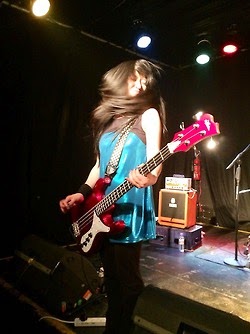


If the Shonen Knife rider really does consist of Snickers bars, marshmallows and gummi bears, as Naoko’s Twitter suggests, it’s easy to see how their sweet-based calories get burned off each night – the band just can’t stand still.  Coupled with the fact the Black Box was hotter than hell during a heatwave, the entire crowd probably sweated off a few pounds over the course of the gig too.


After their main set the band came back onstage for an encore, asking for any audience requests.  Despite the fact I’d only been listening to Shonen Knife for a week, I still felt the need to shout out my request for Choco Bars (the song, not the product).  Another fan requested the track Explosion, and democratic Naoko put the final decision to the crowd.  Needless to say, the vast majority of people also wanted to eat choco bars all day long and my request was played.


The band hung around afterwards for an autograph session, during which Emi and I bonded over bobbed hair.  Well, I say bonded.  I drunkenly pointed at my bobbed hair, pointed at her bobbed hair and she laughed.  With me, not at me.  Honestly.  The ladies graciously hung around long enough to ensure everyone who wanted an autograph got one before helping to pack away their own merch stall and equipment.  Sisters are doing it for themselves.


We left the Black Box exhausted from our relentless pogoing, our hair a terrible sweaty mess with added Hello Kitty hairslides.  It was brilliant.  Shonen Knife are my new favourite band and I want to listen to them all day long.

Wednesday, 14 May 2014

Neil Finn, Dublin Olympia, 30th May 2014


“The doors don’t close, love – especially not for you two!”

Oh dear.  It should have been the time we went into the Olympia to watch Neil Finn’s support act Tiny Ruins take to the stage.  Instead, we were checking with the doorman whether we could definitely still get in once the support act had finished, so we could go drinking instead.

Being the classy ladies we are, my friend and I had already drank pre-mixed G&T and Pims & lemonade on the bus down, and a cocktail each on arrival in Dublin.  As another cocktail started calling to us, we decided to ditch Tiny Ruins, as good as they might have been, to go drink a Harvey Wallbanger and a shot of something foul , in a pub populated with slightly creepy old Irish men.  It was a good idea at the time.

Eventually, we put our glasses down and headed back to the Olympia.  Where we immediately lifted our glasses again, plastic ones this time, filled the foulest wine we ever had the misfortune to drink.  I had been worried that our seats in row L wouldn’t exactly offer a memorable view, so was pleased to see that we actually had a pretty clear view of the stage.  Still for a woman who’s used to being crushed against a barrier in the mosh pit, it took a bit of getting used to.   I also had a pretty clear view of the arse of the man in front of us, who frequently had to stand up for whatever reason, letting his low-riding jeans travel further southward. 

I should add a disclaimer to this, namely that I am a huge Neil Finn fan.  And, as this was my first Finn gig, I was practically jumping up and down in my seat by the time the man himself took to the stage.  Unexpectedly, he began the gig with a piano-led version of Black and White Boy, one of my favourite Finn tracks, so I was sold already.

“It’s good to be back on the sloping stage of the Olympia”, Finn enthused as his backing band joined him on said stage, “though no-one knows why it’s sloping, exactly”.  The set list for the evening obviously contained numerous tracks from Finn’s excellent new album Dizzy Heights, but also ran through plenty of his greatest hits, from his Split Enz days right up to Pajama Club.

I was pleased to hear the Split Enz track Strait Old Line get an airing – it’s not exactly a well known song in this neck of the woods by any means, but is another favourite of mine (hell, they’re all favourites of mine) and Finn performed it in the gospel style he had originally intended.

One particular highlight of the evening came when Finn’s Crowded House band-mate Nick Seymour joined him on stage for a couple of tracks, and even an impromptu dance routine of sorts.  Having never seen Crowded House live myself, it was rather lovely to the see the two of them on stage together, clearly enjoying the brief reunion.


Special mention has to go to the beautiful backdrop behind Finn and his band, designed by former Split Enz cohort Noel Crombie and his partner, Sally Mill.  Thanks to some clever lighting the backdrop appeared to change colour according to the song being played – during Divebomber, for example, the backdrop looked like a gorgeous sunny morning sky as the aircraft sound effects soared across.


The Olympia, Finn told us, has “a soft curfew” and, having recently seen Bruce Springsteen play a three hour set he saw no reason to end his own gig any earlier.  And so it was that Finn came on stage for what amounted to a 12 song encore, just him, his guitar and his piano.  As the evening wore on, people began leaving in order to catch public transport or relieve babysitters of their duties, but if anything this reduction in numbers only improved the atmosphere.

Going to a Neil Finn gig doesn’t feel much like going to a gig at all – instead, it feels as if he has invited quite a lot of people to his rather large living room for a bit of a sing-a-long.   The decreasing crowd served to make the proceedings feel a bit more intimate, and certainly the crowd that remained definitely appeared to sing along much louder than they had been before.

I did, fuelled by alcohol no doubt, attempt to call out a request for Song of the Lonely Mountain which sadly went unheard, but he did play a request for Love Is All That Remains which, in retrospect, was probably a much better choice anyway.

The gig ended with Better Be Home Soon, the audience singing louder than Finn, and considering it was midnight before we left the Olympia, it was an apt choice of song.  My friend and I did attempt to hang around for some Neil Finn Stage Door Action afterwards, but alas, we left empty handed.  Considering the man had just played a three hour set, we could hardly complain.


So, yes, my own fangirlishness probably gets the better of me here and prevents me from saying anything negative whatsoever about the evening.  If I had to make a complaint it would be that seated gigs just don’t do anything for me in general, and I had to make do with dancing in my chair during tracks that were really too good for chair dancing.  However, as a large amount of the gig was Finn performing solo, I admit it was hardly moshing material.

The journalist Peter Paphides once wrote about “Crowded House moments”, where certain songs have defining moments that stay with you forever.  Not having been a Crowded House gig it’s perhaps a bit redundant to talk about that, but those of us in the Olympia that night certainly had a Neil Finn moment anyway. 

Tuesday, 13 May 2014

Robert Newman's New Theory of Evolution, Black Box, 7th May 2014


"I’m reading Tolstoy in Russian....just doing the verbs at the moment”.  And that ought to give you some idea of kind of jokes featured in Robert Newman’s new show, The New Theory of Evolution.

That’s if you can call what Newman offers jokes, of course.  It’s certainly very funny, but it’s essentially a very funny Royal Institution lecture.  The basic premise of The New Theory of Evolution is that neocons have distorted Darwin’s theories, with big business-style interests clinging to the idea of “survival of the fittest” as it’s what fits their ideology best. 

In fact, Newman argues, it’s mutual co-operation and not a dog-eat-dog mentality that has led to the evolution of the species.  “Survival of the misfits”, he calls it, or the idea that that all species originate from misfits pushed to the edges of ecological tolerance in tiny populations.  So definitely not your standard Comedy Roadshow routine, then.

Newman has definitely done his research on the subject – and not just watched the Life on Earth box set, he assures us.  It’s a show full of genuinely interesting ideas and scientific facts.  I particularly liked the research cited on nematode worms, who cannibalise their fellow worms and in doing so, actually appear to consume their knowledge as well as their bodies.

It’s all so packed full of ideas, I couldn’t help but feel there should have been an accompanying reading list.  And of course, it turns out there actually is, on Newman’s own website.  Seriously, comedy gigs with reading lists – more of this, please.

I admit, it’s very much the kind of show people go to in order to feel clever about themselves – you can almost hear everyone in the crowd mentally slapping themselves on the back for getting all the jokes. 

Of course, my friend Ian and I probably have to be included in this mental self congratulation too, especially as we’d had three glasses of wine before Newman took to the stage.  The alcohol did lead to a moment of confusion for Ian towards the end of the first act, as he drunkenly thought Newman was leading up to some vaguely homophobic debunking of the “nature vs nurture” argument.  Exactly how this thought came to him I’m not sure.  Through a wine glass, I assume.

Fortunately, I managed to set Ian straight (as it were) before some very unusual alcohol-fuelled and science-based heckling took place.

Annoyingly, people were still taking their seats once Newman began his routine, so clearly not much of a late door policy, then.  One woman sat down next to me ten minutes into the set and, as if to hide her late arrival, began laughing loudly straight away even though she had effectively walked in mid-sentence.

Considering Newman used to be a stadium filling stand-up pin-up, he appeared to be genuinely quite nervous in the tiny space of the Black Box.  Gone was the ever so slightly arrogant (but, you know, sexily arrogant) technique of old.  Instead, Newman was a little bit stammering and distracted, especially in the face of the Black Box’s bright lights (“We’re not at a disco”).

Pathetic fangirl that I am, though, I was pleased to see that his looks have largely remained intact.  He might not be the long haired, Byronic sex god he once was – now he’s more the ruffled but sexy university professor you’re probably not supposed to fancy.  But hey, that works for me.

I’ve noticed that a number of reviews for The New Theory of Evolution have grumbled either about Newman letting comedy get in the way of a good science lecture, or for letting the lecture get in the way of the jokes.  Personally, I thought there was a good balance of both and admire Newman for being so unashamedly clever.  It might not be the kind of routine that sells out stadiums (to misquote Tim Minchin, you could be as clever as Voltaire but it won’t get you nowhere if you want to sell tickets), but it’s Newman doing the kind of material he wants to do and is clearly passionate about. 

Having said that – the ukulele songs need to go.  I’m happy for the show to be a mix of part-comedy gig, part-lecture, but twee songs played on a small stringed instrument don’t really fit either of those moulds.

Still, ukulele aside, listening to a clever, funny person say clever, funny things makes for a lovely way to spend an evening.  Now, if you’ll excuse me, I have a reading list to get through.  Then, as Newman quipped at the start of the show, “we can all spit into groups and discuss our findings”.


Monday, 7 April 2014

The Tingler

“At any time you are conscious of a tingling sensation, you may obtain immediate relief by screaming. Don't be embarrassed about opening your mouth and letting rip with all you've got, because the person in the seat right next to you will probably be screaming too. And remember - a scream at the right time may save your life.”

We’ve all experienced it – that tingling sensation down the spine in moments of terror.  The fear you’re being followed home down a dark street, strange noises heard in the middle of the night, the realisation otherwise sane human beings actually vote for UKIP – that sort of thing.

What if that tingling wasn’t just a mere feeling?  What if it was caused by a living, parasitic creature that exists in all of us, feeding on your fear then growing and crawling up your spine, even potentially killing you in the process?  That’s the idea behind William Castle’s The Tingler, shown last week as part of the Belfast Film Festival.

The Tingler stars Vincent Price as pathologist Dr William Chapin, who discovers the horrible creature’s existence.  He dubs it ‘the Tingler’ due to the sensation it produces in down the spine and because, as his assistant David proclaims: “since we don’t know what it is yet, we can’t give it a Latin name”.

Fortunately, the Tingler isn’t undefeatable.  The creature can be stopped by simply screaming – letting rip with all you’ve got, indeed. 

Dr Chapin gets the chance to examine a real life Tingler after the untimely death of Martha, the deaf-mute co-owner of a silent movie theatre who is literally scared to death due to her inability to scream.  Realising news of the Tingler would cause untold panic among the public, Chapin decides to hush up his discovery and return the creature to Martha’s body, brought back to the apartment above the movie theatre she had shared with her husband.

But of course, things don’t go quite to plan and the Tingler gets loose, wreaking havoc on the unsuspecting film goers below with terrifying (and unintentionally hilarious) consequences.

William Castle loved to break the fourth wall with various movie gimmicks.  When the movie was first released, this was the point his latest gimmick was deployed in the form of ‘Percepto!’ – basically, electrical buzzers attached to the underside of some chairs in the cinema.  On screen, the Tingler gets into the projectionist’s booth, the silent movie being screened breaks down and the creature crawls across the screen.  It was at this point in the real life cinema the lights would get turned off and ‘Percepto!” would get switched on, giving some unsuspecting cinema goers a jolt as Vincent Price warned them not to panic but to “scream! Scream for your lives!”


Obviously, the Film Festival’s beanbag cinema wasn’t quite able to attach electrical buzzers to the underside of the beanbags.  However they did their best with some large speakers on the floor and the bass turned all the way up to eleven, causing the beanbags to shake and the spine to tingle, well, sort of.   During the shorter scenes this technique didn’t really have enough time to work, but it was most effective during two of the longer set pieces where Dr Chapin embarks on a memorable acid trip in the name of Science, and when poor Martha gets scared to death.

Another technique Castle used when The Tingler was first released was to employ screamers and fainters to attend the film screenings and, well, scream and faint in the theatre.  There were no fainters present among the beanbags, though as most people were watching the movie in a horizontal position it would have been hard to tell anyway.  Pleasingly though there was a screamer present, but of course, she could have just been genuinely unable to cope with all the horror onscreen.

And there is plenty of horror onscreen, though most of it unintentional.  The Tingler hasn’t earned itself the title of camp classic for nothing after all.  Some truly terrible dialogue is coupled with some truly terrible acting for full fearful effect.  “Well, everyone can scream!”, Dr Chapin’s sister-in-law exclaims.  “A deaf-mute can’t scream”, David replies ominously.

If you wanted to look deeply enough, you could probably find something interesting in the film’s subplot involving marriages gone wrong – Dr Chapin’s relationship with his wife is full of adulterous behaviour and matching attempts to kill each other, while the unfortunate deaf-mute Martha is also killed off by her ineffectual little husband.  Unfortunately, the characters are all so one-dimensional that this is never really developed.

The film doesn’t exactly advance the portrayal of women on screen either.  Dr Chapin’s wife is a drinking, smoker adulterer who attempts to kill her husband and possibly killed her father, too.  On the other hand, her sister is a virginal, clean living girl who cheerfully rolls her eyes when the men go off to discuss their highly important men’s work.  And let’s not forget Martha, a deaf-mute bundle of OCD and nerves who gets scared to death by things worthy of the ghost train in a particularly low-budget amusement park.


However, critiquing the plot points of a movie like The Tingler feels a little bit pointless.  It’s b-movie fluff, and highly enjoyable for what it is, especially when it’s a Friday night, you’ve had a glass of wine and are watching the movie from a beanbag, for example.  If you’re a fan of Castle, Price or just campy horror in general, watching The Tingler is a fun way to spend an evening – just as long as you don’t panic and remember to scream.  Scream for your lives!

Sunday, 6 April 2014

Going Dark

                                       
Spending 75 minutes in a darkened room full of strangers might seem like an odd way to spend an evening, well, for most people anyway.  However Sound & Fury’s Going Dark, performed recently at Belfast's Mac, is a play that asks you to do just that.

The play tells the story of Max, an astronomer who learns he losing his sight, and is performed in very low level lighting, sometimes in complete darkness, in order to fully explore Max’s condition.  Part play, part astronomy lesson, the audience is invited for some of the evening to become one of Max’s students, gazing up at astral projections on the ceiling as he walks us through the Milky Way and the history of our universe.

I loved the astronomy lesson aspect of Going Dark.  Max, played by actor and Sound & Fury co-creator Tom Espiner, walks around the small space of the theatre, directing his laser pointer at various constellations and using some neat tricks to explain the birth of stars.  His love and enthusiasm for the subject is obvious, which makes it all the more heartbreaking when he can no longer see the starry projections that are clearly visible above him.

However the real emotional punch of Going Dark is how Max’s worsening condition affects his relationship with his son, Leo.  A single father, Max is determined that he and his son can cope with his blindness together and panics when it is suggested that social services might need to become involved. In one scene, Max even blindfolds himself in an attempt to see if he can still prepare his son’s school lunch and is delighted to find that he can – even if he does almost send Leo off to school with a can of beer.

We never actually see Leo – he appears as an unseen voice – but thanks to some excellent sound direction you find yourself genuinely believing Leo is in the room, even craning your head towards where the sound is coming from to get a better look at the boy who isn’t actually there.  Leo is voiced by Espiner's own son, who was recorded asking questions and chatting away about the subject matter.  The recordings were then edited into individual cues, with Hattie Naylor’s script partly written around these.  This improvisation creates a very natural feel to Max’s interactions with Leo – you believe you are listening to a father talking to his son, rather than an actor reading lines with a stage school brat.

The sound direction is excellent elsewhere, too.  During the scenes where the audience is plunged into complete darkness the sound itself almost becomes a character in the play.  In one scene, for example, you appear to be have been thrown into the middle of deafening traffic that seems to coming at you from everywhere, genuinely making you feel like you’re about to bit hit by a car despite sitting in the middle of a theatre.

The complete darkness is startling at first - and Going Dark's very first 'scene' is in pitch black, as the theatre turns into the great outdoors with crashing thunder, falling rain and birdsong surrounding the audience.  It all does a better job of portraying Max's sight loss than words ever could, as it makes the audience actually experience it rather than just watch a performance.

Tom Espiner is excellent as Max.  Even for a professional actor, performing a one man show in such an intimate venue takes a lot of nerve, and Espiner never loses the audience’s attention for a second.   He perfectly captures Max’s enthusiasm for the stars, the love for his son and the sheer panic his worsening condition causes him – from his confusion during a peripheral vision test, fear caused by the hallucinations he suffers as a side effect and the realisation his very career might be under threat.

The script's attempt at marrying together the various aspects of the play, through Max's assertion that "the universe itself is going blind", is perhaps a little bit forced.  However, Going Dark is ultimately a beautifully realised piece of experimental theatre that fully immerses the audience in a deeply affecting story.

Thursday, 3 April 2014

The Borderlands

There’s a certain snobbishness to found regarding found footage horror movies – unsurprising perhaps, considering the glut of uninspired Blair Witch wannabes that have occupied the market in recent years.  Director Elliot Goldner, however, has proved there are still frights to be had with the genre in his debut film, The Borderlands.

It possibly sounds like the beginning of a very bad joke – an Englishman, a Scotsman and an Irishman walk into a haunted church – but that’s the premise at work here.  Gordon Kennedy, who British viewers will recognise from his roles in, well, everything really plays Deacon, a world wearied priest who has been sent by the Vatican to investigate a supposed miracle in a small country church.  He’s accompanied by fellow priest and Vatican investigator Mark (Aidan McArdle), and technical expert Gray (Robin Hill) who kits the team out with the headcams that capture their footage.

And for once there is at least a reason for team’s use of headcams – although the reasoning behind their entire base camp being fitted with cameras is perhaps a little muddier.  Still, the in-house cameras capture some distinctly creepy scenes early on in the film, such as the untimely church bells chiming in the dead of night and the agonised screams of a sheep that gets set alight by local teenagers, all of which sets the tone for the rest of the film.

The Borderlands does stick to some familiar horror movies tropes – characters going off alone into dark buildings, crucifixes crashing off walls, unwelcoming local villagers who may as well have burning pitchforks – but for the most part it works well here.  The scene where Deacon runs off to the church on in his own in the middle of the night might tick every cliché in the “Horror By Numbers” guide to film-making, but it does also provide some of the movie’s most scary moments.  And once again, this time round there is a genuine reason for it.  Deacon is a man who has a lot to prove after other investigations of his have had terrible consequences.  As he desperately tries to unravel exactly what is happening in the church you at least understand why he heads off into dark crevices on his own – even if you do still wonder if he’s ever watched a horror movie before.

If anything, what makes The Borderlands work so well compared to other found footage movies of recent years is its very MR James-style Britishness.  There are plenty of beautiful – and vaguely ominous – shots of the English countryside setting the mood, for a start.  And instead of nubile young Americans screaming down a camera, here we’re watching a couple of middle aged British men discussing fantastical paranormal happenings over a couple of pints in the local boozer, which seems to make the film’s events all the more believable.  It’s the central double act of Deacon and Gray that serves The Borderlands so well – a sort of Peep Show meets Paranormal Activity style relationship providing laughs amid the ghost hunting.

Notable mention has to go to Robin Hill as Gray, the agnostic techie who is more amazed and eager to believe in the supernatural goings on he witness than the two priests, particularly Mark, who is keen to find a scientific explanation for everything and not drag the church back into the “dark ages”.

Gordon Kennedy and Aidan McArdle both deliver strong performances too, although I did feel the film suffered a little from casting actors who aren’t exactly strangers to mainstream TV shows.  Surely it’s more believable to think you’re watching the found footage of a doomed investigation if you don’t recognise the men on screen from Sherlock or Mr Selfridge?  That’s a minor complaint though, and is possibly a reflection of me watching too much television as opposed to what a general movie going audience might think.


The Borderlands does somewhat lose its way in the final act, after the arrival of elderly priest Father Calvino (Patrick Godfrey) and the plot goes, for want of a better phrase, completely mad.  However the final scenes, which do owe more than a passing nod to The Blair Witch Project, are still thrillingly claustrophobic and deeply unsettling.

Tuesday, 11 February 2014

Brunch at Balthazar

Oh, to be one of the beautiful people...

I’m not sure if Belfast has many places where the beautiful people gather.  If it does, I don’t gather with them.  But as it was our last day in London, we decided to experience a taste of the glamorous life before we returned home, and headed for Saturday brunch in Balthazar, Covent Garden.

Balthazar first opened in New York back in 1997, but now London has its very own branch of the French brasserie.  It opened last year in a blaze of hype, with dinner reservations booked weeks, if not months, in advance.  The hype didn’t appear entirely justified, though, with initial reviews not exactly glowing about the food on offer.  General consensus was that the brunch was much better than the dinner, and as my friend Julie and I couldn’t say no to chance to start drinking in the mornings, we were happy to oblige.

Not that our morning started off very well...we made the mistake of relying on an iPhone to direct us to our destination, with some trademarked Hilarious Consequences.  We realised we were in the wrong part of London entirely ten minutes before our booking, and had to flag down a black cab to get us where we needed to be.  Which turned out to be a ten minute walk from our hotel.  I told you, Hilarious Consequences.

All of which meant we turned up at Balthazar looking less fresh than when we had set out that morning – especially as we had been carting our suitcases around with us, having checked out of our hotel. But that was fine, yes?  Just a relaxed Saturday brunch, who needs to look good?

Ah, yes.  The beautiful people.  I don’t think we expected the Balthazar staff to be quite so beautiful.  Wafer thin bodies, perfectly styled hair, expertly applied make-up...still even if we didn’t get a chance to be beautiful, we got to feel pretty cool.  Balthazar was packed, with even more people piling in behind us.  Requests for brunch from people who hadn’t pre-booked were met with a quick “we can only fit you in for an hour”.  Julie and I, on the other hand, were led to our table by our beautiful waitress, looking at the one-hour brunchers with disdain for not being as damn cool as us.

The interior of the London Balthazar all terribly New York – which is odd, really, considering the interior the New York Balthazar is a copy of French style brasseries.  The tables were fairly small, with not a lot of space between us and our brunching neighbours, but that was fine.  Or at least it would have been fine, if only one of our neighbours hadn’t been an unspeakably pretty, size 0 woman tucking into a giant sticky bun that caused me to a gain 7lbs just looking at it.  Ah, I love the taste of resentment in the morning.

We momentarily felt a pang of panic strike us when we looked at the menu and realised the mimosas we had been planning on drinking were not listed.  Fortunately when we mentioned this to our waitress, she was happy to have two mimosas prepared for us anyway.  Clearly, tourists with burgeoning drinking problems do not faze the staff of Balthazar.

It was decided we would start the brunch with one vaguely healthy dish each.  I opted for the granola with fresh fruit and natural yoghurt, while Julie ordered the fruit salad.  My granola was fabulous, which is not a sentence I say often.  It had a lovely nutty taste to it, and with a generous helping of the yoghurt and plenty of berries, it would have been perfectly filling on its own.


Julie also enjoyed her fruit salad, which appeared to have been covered with a sort of syrup or honey glaze which was beautifully sweet and went well with the fruit.

Healthy options consumed, we then ruined our good intentions with some rapid weight gain in a basket– a basket of assorted breads and pastries.  Balthazar has its own bakery separate to the restaurant, so we had high expectations for this part of the meal.


Our basket contained slices of fresh, white bread which came with three different types of spread to go with them.  Although the chocolate spread mentioned on the menu didn’t seem to materialise, the jams and marmalade we did get more than made up for this.  We particularly loved the marmalade, which tasted like pure oranges turned into a spread, and which Julie felt sure was slightly alcohol-infused.

We also had some chocolate bread to try out, though neither of us was very impressed by it, even if we both liked the idea.  We moved on instead to our croissant, which was the lightest, fluffiest croissant either of us had ever eaten.  The pastry practically melted on our tongues.  The same could be said for the pain au chocolat we had next, although we did feel a little bit more chocolate wouldn’t have gone amiss.

Next in the basket was a giant Danish pastry, filled with plump raisins and covered in sticky glaze with sugary icing drizzled over it.  I would normally avoid Danish pastries as I find them too heavy to be enjoyable, but this too had Balthazar’s light pastry and left us feeling as virtuous as a Danish pastry the size of a man’s head can do.

We left our favourite pastry of all to the end – the almond croissant.  In retrospect, this did mean that by the time we came to eat it, we were almost entirely bread-based, but it seemed like a good idea at the time.  Not to worry, though, as the almond croissant was as gorgeous and light as everything that preceded it.  If I had to be very picky, I would say it could have done with a little bit more almond filling,  but considering I was ready to be rolled out of the restaurant this is a minor point.

When our bill arrived, we noticed it came attached to a Balthazar postcard – not wanting to start an argument in the restaurant over who got it to keep it, we asked our waiter if we could have another one.  He returned with a selection of postcards for the pair of us, which we thought was a nice touch.  Bloody tourists, eh?

People were still crowding into Balthazar as we left, so I would say that booking ahead is a must.  As we emerged blinking into the Covent Garden daylight, our sense of being cooler-than-thou immediately evaporated, leaving us feeling like the travel-worn, pastry-stuffed women we were.  Still, it had been nice while it lasted.

Did we buy anything that couldn’t be bought at your average Caffe Nero on a Saturday morning?  Well, apart from the cocktails, no.  And at just under £70 for the two of us, Balthazar will never been a cost-conscious option.  But if you want a brief taste of being cool along with your croissant – and not forgetting the socially approved morning drinking - it’s a good choice.